Decisioning has become one of the more heavily loaded words in customer technology. It now appears across marketing automation, real-time interaction management, customer data platforms, journey orchestration, customer service, analytics, and AI agent discourse. In each setting the term is doing slightly different work. Sometimes it refers to selecting an offer. Sometimes it means ranking content or deciding a next-best-action. Sometimes it describes a rules engine, a recommendation model, an orchestration pattern, or a real-time arbitration layer between customer context and channel execution.
The variety is understandable because many of these functions do involve decisions. The difficulty is that the term is often stretched across product functionality, architectural placement, and enterprise operating competence as if those were the same kind of thing.
The question of whether decisioning is a feature or a layer is therefore a useful one. It creates the right tension. A feature view forces us to ask what the product actually does. A layer view forces us to ask where decision logic sits in the architecture and how it is governed beyond a single execution surface. That is already a better conversation than most vendor comparisons allow. My position is not that the feature-versus-layer framing is wrong, but that it is incomplete. It opens the door to the more important question: when does decisioning become an enterprise capability?
That matters because decisioning is now being used to frame investment decisions, platform comparisons, operating models, and the role of AI in customer engagement. When a concept carries that much strategic weight, imprecision becomes expensive. A vendor can reasonably define decisioning in terms of what its product does well. A marketing platform may define it around message selection, timing, and activation. A real-time interaction management platform may define it around journey state and adaptive orchestration. A decision hub may define it around centralized arbitration and next-best-action strategies. A composable data platform may define it around warehouse-native activation and audience intelligence. Each definition can be locally valid, yet still insufficient as a general theory.
This is the central problem with much of the current discourse. Product marketing tends to convert an enterprise question into a product-shaped answer. The result is not always false, but it is structurally partial. If the product combines decision logic and execution, the vendor has an incentive to define “true” decisioning as the absence of delay between learning and acting. If the product is a central hub, the vendor has an incentive to define decisioning as enterprise-wide orchestration. If the product is a data platform, the emphasis shifts toward the freshness, completeness, and accessibility of customer data. The underlying pattern is familiar: the product boundary becomes the conceptual boundary.
The problem with defining decisioning by speed
There is a legitimate argument inside the product framing. Latency does matter. A customer signal that arrives too late to influence an interaction has limited operational value. A service failure that does not suppress a promotional message creates waste and damages trust. A real-time eligibility change that is not reflected in the next customer interaction can produce contradiction, risk, or avoidable cost. The distance between learning and acting is therefore a serious design concern.
But latency is a condition of decisioning performance, not the definition of decisioning itself. A decision can be immediate and still be wrong, poorly governed, badly explained, or misaligned with the customer’s actual situation. Conversely, a delay may indicate weakness in one context and proper control in another. The question is not whether action is instant, but whether the enterprise has the discipline to decide appropriately under the conditions of the encounter.
This is where much of the industry’s language around next-best-action becomes too narrow. It improves on static campaign thinking because it forces the enterprise to ask what should happen next for a given customer in a given context. But it can also shrink the problem to intervention, as if the enterprise’s task is always to find the next thing to do. In mature customer systems, decisioning must also include suppression, deferral, escalation, routing, recovery, explanation, and reversal. The more consequential the customer relationship, the less acceptable it is to treat decisioning as merely an engine for the next action.
The stronger concept is arbitration. Selection asks which action wins. Arbitration asks which obligation governs. That distinction matters because enterprises are rarely choosing among neutral options. They are trading off revenue, service, risk, consent, policy, operational capacity, customer effort, and relationship value.
Feature, layer, and capability
A more useful framing is to distinguish between three levels that are often collapsed into one another. Decisioning can appear as a feature inside a product, as a layer within an architecture, and as a capability of the enterprise. These levels are related, but they are not interchangeable.
A feature belongs to a product. A layer belongs to an architecture. A capability belongs to the enterprise.
At the feature level, decisioning includes familiar functions such as rules, rankings, recommendations, eligibility checks, dynamic content selection, next-best-action logic, suppression, send-time optimization, journey branching, offer arbitration, and predictive scoring. These functions are valuable, and in many organizations they may be entirely adequate for the problem at hand. A business with a simple product set, limited regulatory exposure, few channels, and bounded marketing use cases may reasonably satisfy its decisioning needs through embedded features inside an engagement platform. There is no virtue in over-architecting a problem whose consequences remain local.
At the architectural level, decisioning becomes more than product functionality because the decision must remain coherent across systems, channels, processes, and domains. The issue is no longer only whether a tool can choose a message or offer. The issue is where decision logic sits, which systems supply state, how eligibility and consent are enforced, how customer context is assembled, how decisions are observed, and how contradictions are prevented across marketing, service, sales, product, risk, and operations. This is where the language of a decisioning layer becomes useful, provided it is not treated as a universal answer.
Some decisions should remain embedded in execution systems because they are low-risk, local, and latency-sensitive. Others require shared services because multiple channels need consistent suppression, eligibility, or prioritization logic. Others require central arbitration because competing objectives and policies must be resolved at enterprise level. The architecture should follow the decision domain rather than the other way around.
At the capability level, decisioning is broader again. It is the organization’s ability to determine what should happen, what should not happen, what should be deferred, what should be escalated, how the decision should be explained, how its outcome should be measured, and how the enterprise should recover when the decision proves wrong or stale. This is the level at which decisioning becomes part of business design rather than platform design. It includes technology, but it also includes policy, ownership, governance, measurement, operating cadence, decision rights, model control, human override, and customer recourse.
The larger and more consequential the customer system, the more this capability level matters.
Why Business Architecture and Enterprise Architecture both matter
This is also why decisioning should be examined through both Business Architecture and Enterprise Architecture. The distinction is not academic. It is necessary because decisioning sits exactly at the point where business intention becomes system behaviour.
A business-only treatment of decisioning tends to remain aspirational. It speaks of personalization, customer relevance, growth, service quality, retention, or better engagement, but often lacks a precise account of how those ambitions become executable under real operating conditions. A technology-only treatment has the opposite weakness. It can describe engines, rules, models, APIs, events, and integration patterns, yet fail to ask whether the enterprise is making the right kinds of decisions, under the right authority, with the right measures of consequence.
The completeness comes from holding both views together.
Business Architecture asks what decisioning must enable in the business. It examines the capability in relation to value streams, business objects, customer outcomes, policy, ownership, and performance. Enterprise Architecture asks how decisioning is structurally realized across the enterprise. It examines the systems, data, integrations, controls, platforms, runtime patterns, and governance mechanisms that make the capability executable.
In customer technology, this dual lens is especially important because the customer does not experience “the business” and “the technology” separately. The customer experiences the composite behaviour of the enterprise. A promotion sent during a service failure is not perceived as a failure of data architecture or marketing governance. It is perceived as the company acting incoherently. A customer forced to repeat information across channels does not care whether the problem lives in identity, CRM, integration, workflow, or operating model. The burden is experienced as one failure.
This is why decisioning is a useful pivot between business and technology. It exposes whether an enterprise can convert commercial intent, service obligation, customer context, policy, and system capability into coherent action.
The Business Architecture view
From a Business Architecture perspective, decisioning should be understood in relation to value streams, capabilities, business objects, policy, and outcomes. The useful question is not “which platform does decisioning?” but “which decisions determine whether this value stream creates or destroys value?”
In customer engagement, those value streams might include acquiring a customer, onboarding them, resolving a service issue, recovering a failed interaction, renewing a relationship, preventing avoidable churn, managing a complaint, protecting a vulnerable customer, or identifying a legitimate commercial opportunity. Each stream contains decision points. Some are commercial, some operational, some regulatory, some ethical, and some should remain explicitly human.
A decision to send a retention offer may also be a decision about service state, complaint sensitivity, eligibility, margin, consent, and relationship posture. A decision to suppress contact may express a customer protection policy, a saturation threshold, a legal constraint, or a service recovery principle. A decision to escalate a customer may reflect the economic value of the relationship, the seriousness of the issue, the probability of harm, or the limits of automation.
Business Architecture makes those decision relationships visible.
It also forces the question of ownership. Decisioning is often discussed as if the difficult problem is analytical or computational. In practice, many of the harder questions are managerial. Who owns the decision policy? Who defines the objective function? Who is allowed to trade off short-term revenue against long-term relationship value? Who approves the use of a model? Who can override the decision? Who monitors downstream consequences? Who retires a rule or treatment when it begins to cause harm?
These are capability questions. A business that cannot answer them may still own sophisticated decisioning software, but it does not yet have mature decisioning capability.
Business Architecture also helps distinguish different decision domains. Marketing decisions, service decisions, eligibility decisions, risk decisions, recovery decisions, and customer protection decisions have different owners, time horizons, constraints, and success measures. Treating them all as “decisioning” may be convenient at the product level, but it is not precise enough for enterprise management.
The Enterprise Architecture view
Enterprise Architecture takes those business requirements and examines the structural conditions required to make them operable. It asks where decision logic should reside, which decisions should be centralized or federated, which data sources are authoritative, which events trigger evaluation, which policies must be enforced at runtime, how decisions are consumed by channels, and how decisions are logged, explained, monitored, tested, and corrected.
It also asks how decisioning interacts with identity resolution, consent management, customer data platforms, data warehouses, CRM, marketing automation, service systems, digital experience platforms, contact-centre tooling, content systems, experimentation platforms, product catalogues, and core transactional systems.
This is where simplistic architectural answers tend to fail. A single central decision engine may provide consistency, but it can also create latency, dependency, and organizational bottlenecks if applied indiscriminately. Fully embedded decisioning may preserve local speed but create incoherence across the enterprise. A federated pattern may offer a better balance, but only if domains conform to shared standards for identity, policy, observability, model governance, and outcome measurement.
The architecture should therefore classify decisions by consequence, volatility, latency requirement, regulatory exposure, explainability need, and scope of reuse. Choosing an email send time is not the same class of decision as determining financial eligibility, suppressing contact for a vulnerable customer, escalating a complaint, or recommending a retention intervention during an unresolved service failure.
This is the point at which decisioning becomes a genuine enterprise architecture concern. Not because every decision needs to be centralized, but because every consequential decision needs to be made coherent with the enterprise’s information, policy, system, and governance structures.
Capability realization: where the two views meet
The bridge between Business Architecture and Enterprise Architecture is capability realization.
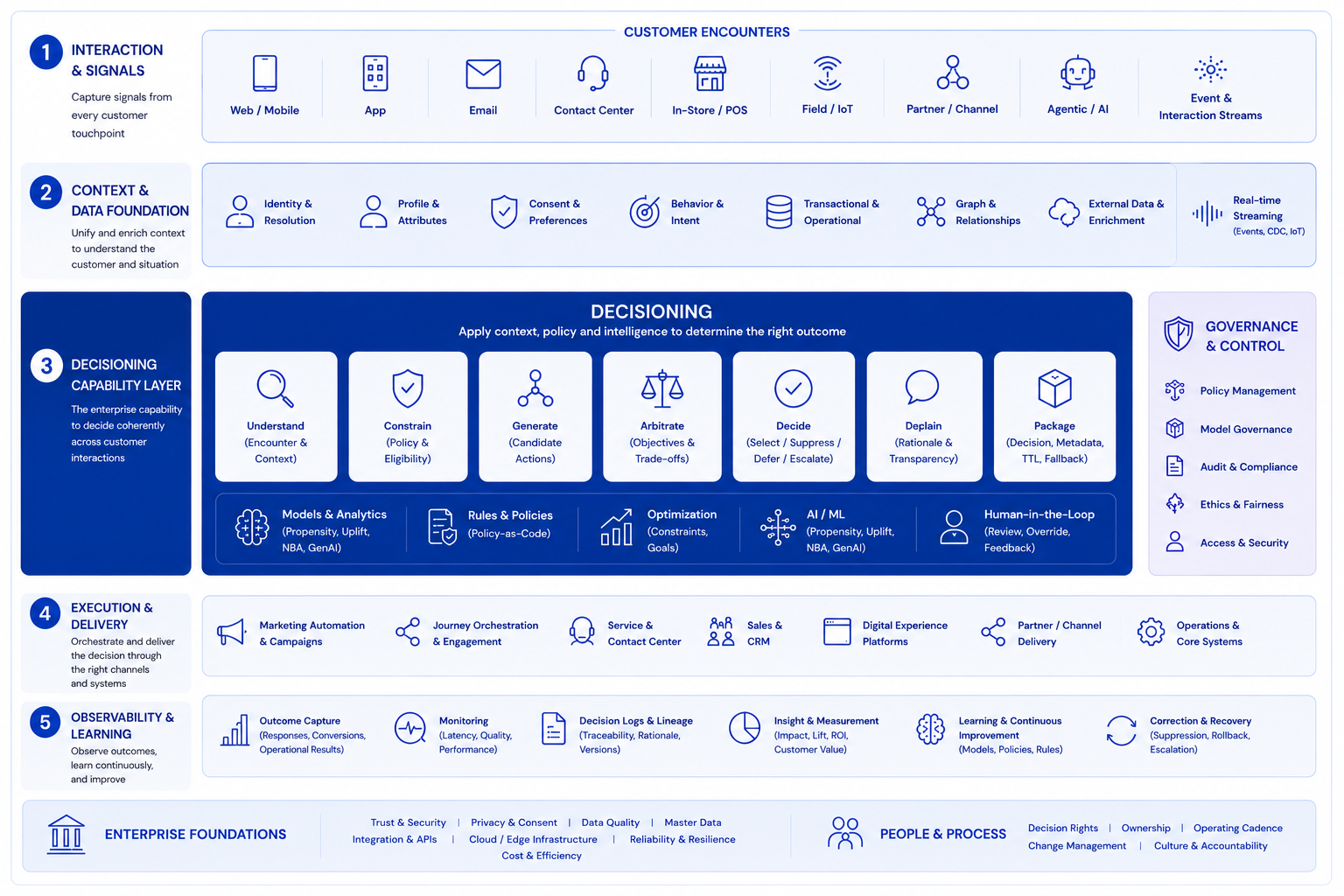
A capability is not real because it appears in a capability map, a strategy deck, or an architecture diagram. It becomes real when the enterprise can perform it repeatedly under operating conditions. For decisioning, that means the organization can recognize the relevant customer or entity, understand the situation sufficiently, assemble legitimate context, apply policy and eligibility constraints, arbitrate between competing objectives, execute the decision through the appropriate surface or process, observe the outcome, explain what happened, and correct course when required.
If any of those elements are absent, the capability is partial regardless of how advanced the tooling appears.
This is where many enterprises get into trouble. They buy decisioning features and call it capability. They implement a decisioning platform and call it architecture. They centralize rules and call it governance. They add AI and call it intelligence. But the customer still receives contradictory messages. The agent still lacks context. The service state still does not suppress the campaign. The model still optimizes for a proxy. The consent state is still stale. The decision still cannot be explained. The correction path still does not exist.
The capability is therefore not proven by the presence of a decisioning product. It is proven by the enterprise’s ability to produce coherent decisions under real customer, operational, and technical conditions.
The encounter as the practical unit of decisioning
This is why the customer encounter is such an important unit of analysis. Decisioning does not happen to an abstract customer profile; it happens in a situated interaction. There is a person, account, household, device, organization, or agent involved. There is a channel or surface. There is timing. There is a business process. There is an intent, whether expressed, inferred, or misunderstood. There are constraints and consequences.
The enterprise may experience this as data, logic, policy, and execution, but the customer experiences whether the organization acted appropriately in the moment. Did it recognize the service issue before sending the promotion? Did it avoid asking for information already provided? Did it respect consent and context? Did it suppress action when action would have been intrusive? Did it escalate when automation was insufficient? Did it recover when the system was wrong?
This encounter-level view is important because it disciplines the idea of context. It prevents the enterprise from treating customer context as an infinite accumulation problem and instead asks what context is relevant, legitimate, timely, and sufficient for this decision in this situation. That distinction becomes more important as AI increases the volume and speed of decision-like activity across the enterprise.
What a serious decisioning architecture implies
A serious technical architecture for decisioning has to reflect this situated nature. At scale, decisioning is not a single box in a diagram, but an ecosystem of design-time and runtime capabilities.
Interaction surfaces generate events and request decisions. An encounter capture layer normalizes meaningful interaction events, applies correlation identifiers, distinguishes raw telemetry from encounter state, and preserves the minimum context needed for continuity. Identity and entity resolution determine whether the decision applies to a person, household, account, organization, device, authenticated user, anonymous visitor, or related party. Context assembly retrieves the relevant and legitimate information required for the decision, rather than indulging the fantasy that the enterprise needs or owns a complete customer reality.
The contemporary infrastructure required to support this at scale is substantial. High-volume event streaming, usually through Kafka-like or cloud-native pub/sub patterns, carries behavioural, transactional, service, and system events into the decisioning environment with bounded latency. Stream processing and complex event processing identify meaningful patterns while the encounter is still alive. In-memory databases, distributed caches, low-latency feature stores, and online model-serving infrastructure provide the speed required for real-time eligibility, scoring, and arbitration. Graph databases or graph projections help represent customer, account, household, product, intent, policy, journey, and encounter relationships that cannot be reduced cleanly to flat profile attributes. Vector retrieval and semantic layers increasingly support content, knowledge, intent, and agentic use cases, while AI models provide propensity, uplift, classification, summarization, anomaly detection, and recommendation capabilities. Edge networking and regional execution patterns may be required where latency, sovereignty, resilience, or channel proximity matter. Around all of this sit API gateways, event meshes, policy-as-code, observability pipelines, model registries, experimentation frameworks, lineage controls, and runtime audit trails. The point is not that every enterprise needs every component. The point is that serious decisioning, once treated as an enterprise capability, reaches from business architecture all the way down to streaming infrastructure, memory, graph, model, and network design.
Policy and constraint services then determine what is permissible. Consent, eligibility, contact policy, legal restriction, vulnerability rules, contractual obligations, regional regulation, service commitments, and brand governance all shape the decision space before optimization should begin. Candidate actions are then evaluated through a combination of rules, decision tables, models, business priorities, propensity scores, uplift estimates, inventory constraints, operational capacity, and human-defined thresholds.
Mature decisioning then arbitrates across conflicts rather than merely ranking candidates. The output should not be just an action, but a decision package: selected action, rationale, constraints applied, context used, confidence, expiry period, fallback, trace ID, policy version, model version, and explanation requirements.
Execution systems carry out the decision, but execution is only one part of the loop. The decision must be observed in terms of technical delivery, customer response, operational consequence, model performance, policy compliance, and downstream contradiction. Decision logs, policy traces, model telemetry, drift detection, fairness checks, override analysis, suppression accuracy, latency monitoring, recovery rates, and customer-impact measures all become part of the capability.
Without this observability, decisioning becomes difficult to distinguish from automated superstition: the system acts, but the enterprise cannot adequately explain, challenge, or improve the basis on which it acted.
The neglected discipline of correction
The least developed part of many decisioning conversations is correction. The industry speaks fluently about optimization and less comfortably about reversibility. Yet the quality of a decisioning capability is revealed not only when the decision is right, but when it is wrong.
Data may be stale. Identity may be misresolved. Intent may be misread. Consent may have changed. A service event may invalidate a commercial action. A model may optimize a proxy that no longer reflects the business or customer outcome intended. A customer may contest the result. An agent may override the recommendation. A later event may expose the decision as inappropriate.
Mature decisioning therefore requires expiry, rollback, suppression, compensation, escalation, and learning mechanisms. A system that cannot correct itself may be fast, but it is not yet trustworthy.
This is also where the dual architecture lens becomes practical rather than conceptual. Business Architecture defines what kinds of correction, recourse, ownership, and accountability are required. Enterprise Architecture determines whether the system can actually detect, trace, reverse, suppress, escalate, or compensate when correction is needed.
And one more thing
The decisioning debate should move beyond the simple question of whether it is a feature or a layer. That distinction is useful, and it is a valuable starting point because it surfaces the tension between product functionality and architectural control. The next step is to ask when decisioning becomes an enterprise capability.
Decisioning is expressed through architecture and delivered through products, but its meaning is determined by whether the organization can make coherent, governed, explainable, and correctable decisions across customer interactions.
This is why Business Architecture and Enterprise Architecture both matter. One defines the capability in relation to value, policy, ownership, and consequence. The other makes the capability operable through systems, data, controls, integration, and governance. Together, they give decisioning the completeness that product-level discourse usually lacks.
In customer technology, the standard is not how quickly a system can act. The standard is whether the enterprise can act with sufficient relevance, restraint, legitimacy, and accountability in the encounter where the decision becomes real.