Why Revisit This Conversation Now?
Over the past year, the marketing technology conversation has been overtaken by a single theme: AI.
Generative AI.
Autonomous marketing.
Agentic systems orchestrating campaigns, content, and customer journeys.
In many corners of the MarTech industry, the narrative has already shifted. The architecture of tomorrow, we are told, will be defined by AI agents coordinating marketing activities across the stack.
But that raises a deeper question that deserves closer examination.
Does the rise of agentic AI actually change the architecture of marketing technology?
Or are we once again mistaking a powerful new capability for the architectural foundation itself?
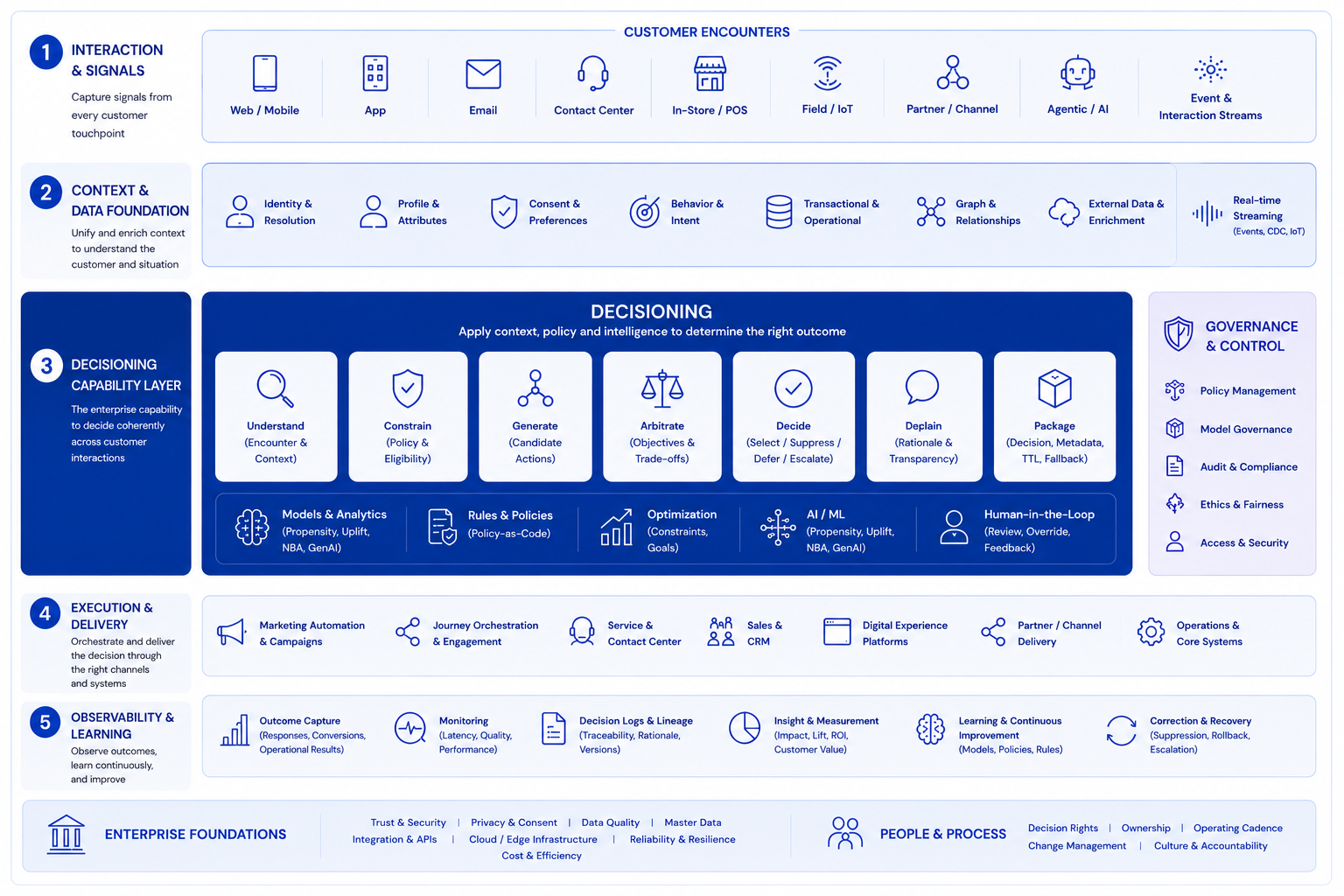
The last time we explored the Martech Architecture of Tomorrow, the argument was straightforward: the architecture of marketing technology should be organized around customer engagement, not tools, platforms, or vendor categories.
Today, with the rapid emergence of AI-driven systems, it is worth revisiting that premise.
Not to discard it — but to test it.
Because if the rise of agentic AI truly represents a structural shift in MarTech, then the engagement-centered view of architecture should no longer hold.
But if engagement remains the fundamental organizing principle of marketing systems, then AI may turn out to be something else entirely:
not the architecture of MarTech — but the intelligence operating within it.
The Architectural Problem AI Does Not Solve
For more than a decade, the marketing technology industry has attempted to solve an architectural problem using tools.
Stacks grew larger.
Platforms became more specialized.
Capabilities multiplied.
Yet despite this technological expansion, most organizations still struggle with a familiar challenge:
Coordinating meaningful interactions between businesses and customers across an increasingly complex set of channels and contexts.
This is not primarily a tooling problem.
It is an architectural one.
At its core, marketing technology exists to support engagement — the ongoing interactions between a company and its customers.
Regardless of how technology evolves, customers will still:
- explore products
- ask questions
- respond to offers
- request support
- abandon journeys
- return later
- interact across multiple channels and moments
These interactions — these encounters — are the raw material of marketing.
And this is precisely where the Engagement Fabric perspective becomes important.
From Journeys to Encounters
Traditional marketing technology architecture was built around a concept that felt intuitive at the time: the customer journey.
Journeys assumed that interactions between companies and customers could be designed as structured paths.
A customer enters a funnel.
They move through stages.
Campaigns and messages guide them forward.
This model worked when interactions were limited, channels were fewer, and marketing execution was largely deterministic.
But modern engagement environments are no longer deterministic.
Customers do not follow designed journeys.
They move through a constantly shifting landscape of interactions:
- a search query
- a product comparison
- a support conversation
- a social interaction
- a website visit
- a purchase
- a return
Each moment represents an encounter — a discrete interaction between a customer and a business.
Journeys, when they appear, are simply patterns that emerge from sequences of encounters.
This is the core insight behind Encounter Anatomy.
Engagement is not built from journeys.
It is built from encounters.
And if encounters are the fundamental unit of engagement, then marketing technology architecture must be able to capture, contextualize, and respond to those encounters in real time.
Where Agentic AI Actually Fits
This is where the recent excitement around agentic AI becomes interesting.
Agentic systems promise to:
- interpret context
- plan actions
- execute decisions
- coordinate across systems
- adapt interactions dynamically
In other words, they promise to reason over interactions.
But reasoning requires structured inputs.
Agentic systems need:
- context
- memory
- goals
- tools
- boundaries
In an engagement-centered architecture, those inputs already exist.
They come from the encounter stream itself.
Every encounter contains structured information:
- who initiated the interaction
- what occurred
- where it happened
- when it occurred
- why it happened
- how the system responded
This encounter anatomy provides the situational awareness necessary for intelligent systems to operate.
Without it, agentic systems lack the context required to make meaningful decisions.
Which leads to a provocative conclusion.
AI Does Not Replace Engagement Architecture
AI does not replace the architecture of marketing technology.
It depends on it.
Agentic AI may transform how engagement is executed — making it more adaptive, contextual, and autonomous.
But the structure that makes those capabilities possible remains the same.
The architecture of marketing technology must still organize itself around engagement.
The difference is that engagement systems are no longer purely deterministic.
They are becoming intelligent environments capable of sensing, interpreting, and responding to encounters as they occur.
The Real Architecture of Tomorrow
If anything, the rise of AI strengthens the case for engagement-centered architecture.
Because intelligence without structure quickly becomes chaos.
The architecture of tomorrow will not be defined by stacks or platforms.
Nor will it be defined by AI agents alone.
It will be defined by systems capable of capturing and contextualizing encounters, coordinating engagement across channels, and enabling intelligent decision-making within those interactions.
In other words:
The architecture of tomorrow is still engagement architecture.
AI simply becomes the intelligence operating inside it.
The AI Trap: Why Most Agentic Martech Will Fail
The excitement around agentic AI in marketing technology is understandable.
Autonomous systems that can analyze context, decide on the next best action, generate content, and execute engagement in real time sound like the natural evolution of marketing automation.
But there is a structural problem hiding behind this promise.
Most organizations are trying to introduce agentic AI into architectures that were never designed to support intelligent systems.
The typical MarTech environment still looks like this:
- Disconnected applications.
- Fragmented customer data.
- Channel-specific engagement tools.
- Journey orchestration engines operating in isolation.
- Campaign logic scattered across platforms.
In this environment, an AI agent does not become intelligent. It becomes confused.
Without a coherent model of engagement, the agent has no reliable understanding of the situation it is acting within.
It does not see engagement. It sees fragments.
A website event here.
An email interaction there.
A CRM record somewhere else.
From the perspective of the system, these events are not connected encounters. They are disconnected signals.
An intelligent system placed in that environment can generate activity, but it cannot produce coherent engagement.
The result will not be autonomous marketing.
The result will be automated chaos.
This is the real trap of the current AI wave. Organizations are trying to add intelligence before they have established the structural foundation that intelligence requires.
Agentic systems need more than APIs and data feeds. They require a coherent engagement model.
They need a structured stream of encounters.
They need context that persists across interactions.
They need clear boundaries for action and decision making.
This is precisely what the Engagement Fabric was designed to address.
The Engagement Fabric treats encounters as the fundamental unit of customer interaction. Each encounter is captured with its full anatomy. Who initiated it. What occurred. Where it happened. When it occurred. Why it occurred. How the organization responded.
When encounters are captured in this way, engagement becomes observable.
Patterns begin to emerge.
Journeys can be derived from sequences of encounters.
More importantly, intelligent systems can reason over those encounters.
They can understand context.
They can interpret intent.
They can evaluate possible actions.
And they can operate within defined boundaries.
Without this fabric of encounters, AI systems are left guessing.
The irony is that the more powerful the AI becomes, the more damaging this architectural gap becomes.
A deterministic rule engine makes limited mistakes.
An autonomous system operating without coherent engagement context can make mistakes at scale.
"The Future is Not Agentic. It Is Encounter-Aware."